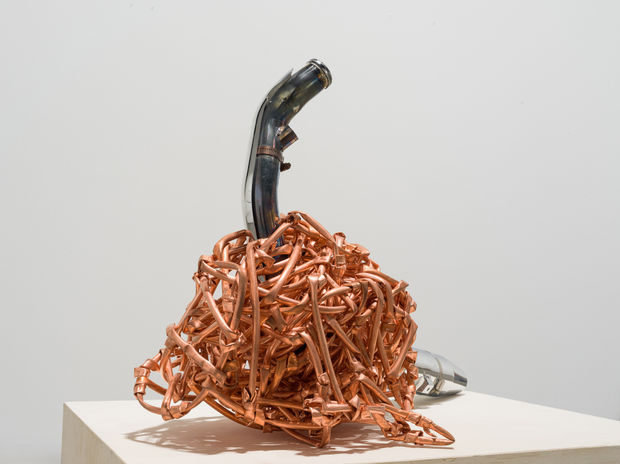
Gallery Isabelle is pleased to present The Leap Between, a solo booth dedicated to the late Emirati artist Hassan Sharif (1951–2016), one of the most influential figures of conceptual and experimental practice in the Middle East.
In the early 80s during summers, spent back home while he was attending art school in London, Hassan Sharif executed a series of simple actions in the harsh desert landscape outside Dubai. Documented in a few black-and-white photographs, these early performances involved simple activities – walking, jumping, throwing stones, digging, and and then standing in a hole in the sand – that resemble elementary forms of child’s play, the kinds of basic movements through which we, especially as children, map out and acquaint ourselves with the spatial and material conditions of our surroundings. More complex task-based actions would follow, carried out in the confines of his modest home and studio back in the city. Composed of sets of simple instructions, these resembled the sorts of made up games one might concoct to relieve the unrelenting boredom of the sultry days of summer in the early 80s Dubai. Sharif continued to produce such provocative “Experiments” and “Performances”, as he called them during his studies at the Byam Shaw School of Art, and brought this commitment to radical and experimental art practice back with him to the UAE upon completing his degree in 1984.
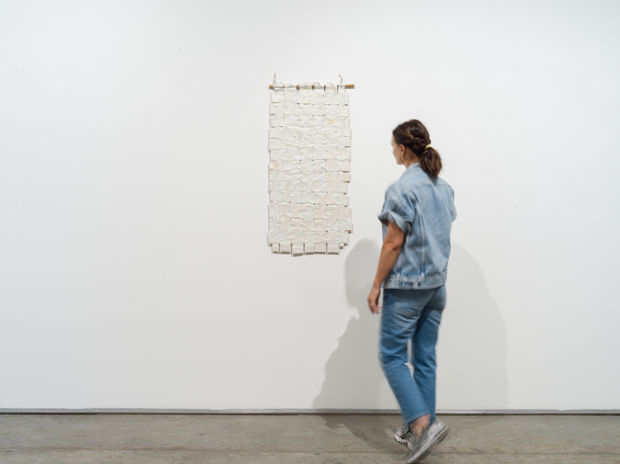
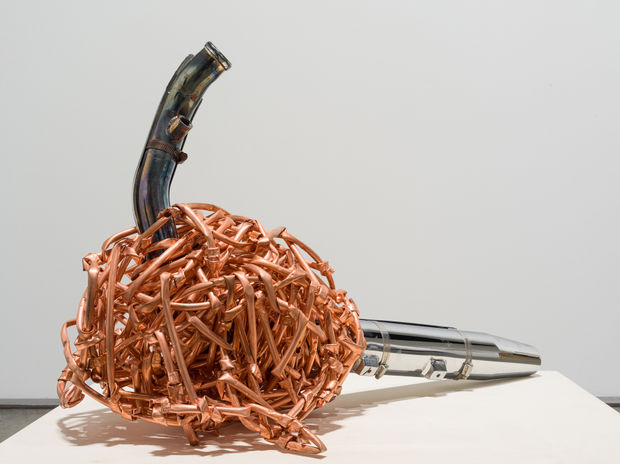
This exhibition invites viewers into the leap between inception and completion—a leap in which becoming is not a stage toward an end, but the very condition of the work. Whether through the improvisation of 'Objects' or the calculated constraints of 'Semi-Systems', in Sharif’s world, art is a living process, one in which the artwork continuously negotiates what it is and what it might yet become.
-

-
-
Two works on paper from the Squares series—Squares No. 1 (2013) and Squares No. 4 (2013) —further articulate Sharif’s engagement with repetition, seriality, and the limits of sameness. Composed of black squares repeated across the surface, the works attempt to render each unit identical, yet subtle variations inevitably emerge through the hand- drawn process. The grid is not imposed but activated by the white background of the paper, which functions as both structure and interval, while the negatives produced through the overlaying of filled squares generate shifts in density, rhythm, and perception. What initially appears as a rigid system reveals itself as porous and unstable, shaped by accumulation and minor deviation.
-
-
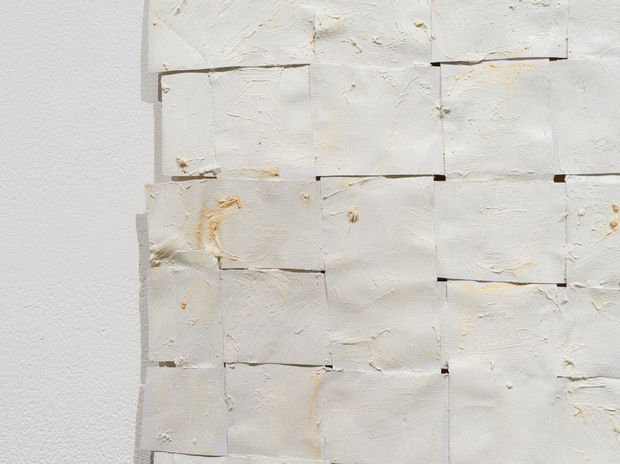
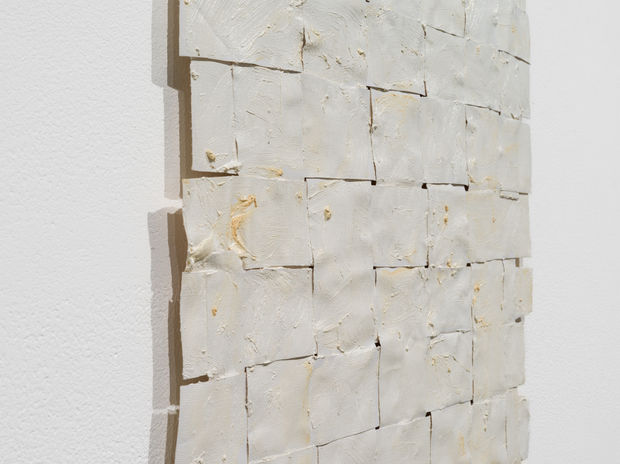
Influenced by Marcel Duchamp and Fluxus International, Sharif turned his attention to the ordinary and the common place, investigating the artistic potential of banal objects and everyday actions. His process is humble and direct, involving the seemingly obsessive repetition of mundane manual tasks—cutting, folding, rolling, twisting, knotting, tying, plaiting, weaving, binding, gluing, and wrapping. Monotonously reiterated, these gestures resemble those of a machine or an assembly line, mirroring industrial systems of production. The actions produce numerous small, discrete units that are simply piled, bundled, or strung together and hung to form larger assemblages. Increasingly wary of growing wasteful consumption, Sharif also began to work with discarded materials.
Increasingly wary of growing wasteful consumption Sharif also began to use waste material. In Aluminium Container (2016), Sharif packed gravel in aluminium containers and bound the units with rope. Here, form and function are suspended in an unresolved state, caught between the object’s previous life and its potential futures.
-
-
-
-
Arish (2008) is a model for a public work by Hassan Sharif that was never realised, functioning as a blueprint for a speculative future and a conceptual artefact of a process that persists despite its absence. Composed of an artist sketch and a scale model, the project reveals Sharif’s ambition to fabricate a monumental bronze sculpture rising over six metres high, inspired by traditional arish shelters once used across the Arabian Peninsula. These summer structures were ingeniously built from palm fronds—leaves left intact to form ventilated roofs or stripped away to create permeable screens—offering shade while allowing air to circulate. Drawing on this vernacular architecture, Sharif translated indigenous methods of construction into sculptural form. In an important essay from the mid- 2000s, he described his practice as a form of weaving—an ancient technique essential to regional craft traditions in which dried and plaited date-palm leaves were used to make mats, baskets, and trays, while stronger midribs formed crates and roofing elements, practices historically carried out by Bedouin women and still maintained in rural communities. By aligning his work with these forms of domestic and communal labour, Sharif asserted solidarity with the largely unacknowledged bodies that performed them, revitalising an ancient handicraft as a language of contemporary art and foregrounding an ethic of labour, care, and quiet feminist resistance embedded within making itself.
-
HASSAN SHARIF
-
Read More
Hassan Sharif (1951-2016) made a vital contribution to conceptual art and experimental practice in the Middle East through forty years of performance, installation, drawing, painting, and assemblage. Prior to leaving the U.A.E to study in London in 1979, Sharif gained attention for his cartoons published in the U.A.E press—ironic, outspoken critiques of the rapid industrialisation of the Emirates and the political deadlock of 1970s Arab Nationalism. As an artist, he rejected calligraphic abstraction, which was becoming the dominant discourse in the Middle East at that time, and pursued instead a pointedly contemporary vocabulary, drawing on the non-elitism and intermedia of Fluxus and the potential in British Constructionism's systemic processes of making.
In addition to his own practice, he also encouraged and supported several generations of artists in the Emirates. Sharif was a founding member of the Emirates Fine Arts Society (1980) and the Art Atelier in the Youth Theatre and Arts in Dubai. In 2007, he was one of the four artists to establish The Flying House, a Dubai institution for promoting contemporary Emirati artists.